

The Complete Guide to Adult Learn to Swim in Sydney
If you are considering adult learn to swim Sydney options, understanding how adults actually learn in the water can help you choose the right approach.
Whether you have never learned to swim, lost confidence over time, or simply want to feel safer and more relaxed in the water, learning to swim as an adult is entirely possible.
Learning as an adult is different from learning as a child. Adults bring life experience, expectations, established movement patterns and sometimes fear into the water. They may also want to understand why a skill works and how it fits into the whole stroke.
Good adult swimming instruction recognises these differences. Learning is not simply about completing lengths. It is about developing breath management, confidence, body awareness and coordinated movement through understanding, quality repetition and purposeful practice.
This guide explains what learning to swim as an adult can involve, why the process may feel different, and what to look for in a learning environment that supports steady, sustainable progress.
1. Why Adults Learn Differently from Children
Learning to swim is a process of learning movement. Like any complex physical skill, it develops through understanding, repetition, feedback and practice.
A useful way to understand this process is through three broad stages of skill learning: cognitive, associative and autonomous.
In the cognitive stage, the swimmer is working out what to do. There can be a lot to think about, which is why clear demonstrations, simple explanations and breaking the stroke into manageable pieces can be so valuable.
During the associative stage, those pieces are practised and refined. Repetition matters, but so does the quality of that repetition. Feedback helps the swimmer recognise what an effective movement feels like, make adjustments and gradually connect individual skills into a more coordinated whole.
Eventually, with sufficient quality practice, aspects of the movement become autonomous. The swimmer no longer needs to consciously control every action. Breath management, balance and movement begin to work together with less thought and effort.
Adults go through this learning process just as other learners do, but they do not arrive at the pool as a blank slate.
They bring previous experiences, expectations and established movement patterns with them. Someone who has felt uncomfortable in water for many years may have developed automatic responses such as holding their breath, lifting their head, becoming rigid or rushing their movements. Another adult may already be comfortable in water but have repeated an inefficient swimming pattern for decades.
This is why simply telling an adult what to change is rarely enough.
New movement needs to be understood, practised in manageable chunks, repeated with purpose and supported by useful feedback. Over time, a new pattern can become increasingly familiar and automatic.
Good adult coaching therefore is not about asking someone to think about ten things at once. It helps the swimmer understand one manageable piece, practise it successfully, refine it and then integrate it into the whole stroke.
2. Is It Ever Too Late to Learn to Swim?
This is one of the most common questions adult coaches hear. The answer is no.
People learn to swim successfully in their 30s, 40s, 50s, 60s and beyond. Adults can bring qualities that help them learn well: motivation, patience, curiosity and a willingness to understand and practise deliberately.
Progress may not happen overnight, but improvement is possible at almost any age.
Success should also be measured in a number of ways, meeting the swimmer’s milestones along the way. For one adult, success may mean putting their face in the water calmly. For another, it may be floating comfortably, swimming with family on holiday, completing several relaxed freestyle laps or eventually swimming independently over longer distances.
Every swimmer starts from a different place. Comparing yourself with someone who has been swimming since childhood is rarely useful. A better measure is whether your own movement, confidence and independence are developing from your starting point.
3. Understanding Fear, Confidence and the Nervous System
Many adults do not struggle because they lack strength or fitness. They struggle because the water does not yet feel safe.
For some people this follows a frightening or challenging experience. Others remember childhood lessons that felt rushed or overwhelming. Some have experienced embarrassment around swimming, while others simply feel uncomfortable putting their face in the water, or being unable to touch the bottom.
When the body perceives threat, protective responses can appear. Muscles may tighten, breathing can become less controlled and attention can narrow towards staying safe rather than learning a new movement.
These responses can make learning harder, but they do not mean someone is incapable of learning to swim.
Good adult coaching recognises the swimmer's starting point rather than trying to force them through it. Skills can be introduced progressively, in manageable steps, so that the swimmer repeatedly experiences control and success.
Understanding what the body is doing in the water can also reduce uncertainty. Learning how the water supports the body, how to manage the breath and how small changes in position affect balance can help replace a sense of threat with increasing familiarity.
Confidence is not built by simply telling someone to relax or be brave. It develops through repeated experiences, that show the swimmer they can manage the situation.
As the water becomes more familiar and breath management becomes calmer, unnecessary tension can reduce and attention becomes more available for learning.
4. Why Breath Management Comes First
Breath management and breathing during freestyle are not the same thing.
For an adult learning to swim, breath management can begin before the mechanics of turning the head to breathe within the stroke. Trying to add freestyle breathing too early can give a new swimmer another complex movement to think about before their basic stroke pattern feels settled.
The first goal is simpler: helping the swimmer become comfortable managing their breath while their face is in the water.
Many new swimmers instinctively hold their breath, brace their body or release their air suddenly. These responses can increase tension and create a feeling of urgency. Instead of being available to learn a new movement, much of the swimmer's attention may be occupied by the need to get to the next breath.
A calm, controlled exhalation can change that experience.
Gentle nasal exhalation is one useful strategy. The relationship between breathing and the autonomic nervous system is complex; but slower, controlled breathing and longer exhalation are associated with physiological responses linked to relaxation and parasympathetic activity. Nasal breathing also has physiological effects involving nitric oxide, which plays a role in vascular function.
For the swimmer, however, the practical outcome is more important than the terminology.
When breath feels controlled, urgency can decrease. Muscle tension can reduce. Attention becomes more available for learning.
This matters because swimming is a complex motor skill. A beginner needs enough mental space to notice body position, balance, direction and movement. If most of their attention is occupied by getting air, it becomes much harder to practise those skills effectively.
This is why early practice can be particularly effective over short, manageable repeats rather than continuous lengths of the pool.
The swimmer might practise only a small number of strokes before stopping, resetting and repeating. The objective is not distance. It is to give the brain repeated opportunities to experience and refine one successful movement pattern while breath remains calm and controlled.
Over time, those quality repetitions help the movement become more familiar. The swimmer can gradually connect more pieces of the stroke without having to consciously control every detail.
Only once a swimmer has begun to establish a calm, repeatable stroke pattern does breathing need to be integrated into that movement.
At that point, breathing is not something that interrupts the stroke or dictates it. It can be progressively fitted around a movement pattern the swimmer already understands.
Breath management comes first. Freestyle breathing comes later.
5. Swimming Is a Skill Before It Is Fitness
It is easy to think that becoming a better swimmer means becoming fitter.
For a beginner, however, swimming is first and foremost a movement skill.
Early progress is less about metabolic conditioning and more about developing coordination: teaching the brain and body to organise breath management, balance, body position, rotation and movement through the water.
This distinction matters.
If a new swimmer is asked to complete longer distances before an efficient movement pattern has begun to develop, fatigue can quickly change the way they move. They may lift the head, hold the breath, rush the arms or revert to movements that simply help them reach the end of the pool.
The problem is that these deteriorating movements are then being repeated and practised. Instead, short practice repeats allow the swimmer to reset frequently, maintain attention on the movement being learned and build a more effective pattern through quality repetition.
Efficient swimming is not simply pulling and kicking harder
Freestyle is sometimes described primarily in terms of the arms pulling backwards and the legs kicking. That description can encourage beginners to think that swimming successfully requires more effort.
Efficient freestyle is better understood as coordinated movement of the whole body through the water.
Rotation around the body's long axis plays an important role in this coordination. Rather than the arms and legs working as separate parts, the body rotates and moves as an integrated system. The arms connect with that movement rather than simply trying to pull the swimmer forwards through muscular effort.
For a beginner, understanding this can be liberating. The goal is not to fight the water. It is to learn how to organise the body so that movement becomes increasingly balanced, coordinated and efficient.
As the stroke becomes more coordinated and repeatable, distance can be increased progressively without significant deterioration in movement. Greater conditioning then develops naturally as the swimmer becomes able to sustain an efficient stroke for longer periods.
6. Learning One Piece at a Time
Freestyle is a complex skill. A swimmer may eventually coordinate body position, rotation, arm recovery, timing, breath management and breathing without consciously thinking about each component. A beginner cannot.
Asking someone to concentrate on all of those things simultaneously creates cognitive overload. This is why breaking a complex skill into smaller, manageable pieces - often called chunking - is so valuable.
A swimmer might initially work on just one aspect of movement. They practise it over a short distance. They stop. They consider what happened. They receive feedback if appropriate. Then they repeat it.
The distance covered may be very small, but the amount of learning taking place can be significant.
Repetition matters - but so does what you repeat
Repetition is fundamental to motor learning. However, simply repeating a movement does not guarantee that it will improve.
If a swimmer repeatedly completes long distances while holding their breath, lifting their head or rushing their stroke, those patterns can themselves become increasingly familiar.
This is why quality of repetition matters as much as quantity.
Short repeats allow a learner to maintain attention on the skill being practised. They also provide natural opportunities to stop, reset and begin again before fatigue or loss of concentration significantly changes the movement.
As the skill becomes more consistent, the swimmer can gradually increase the number of strokes or distance while maintaining the same quality.
Eventually, separate pieces begin to connect. What initially required considerable conscious thought becomes more familiar, and ultimately some aspects of the movement become automatic.
For adults who are keen to improve quickly, this can initially feel counterintuitive. Swimming fewer metres can sometimes produce more learning.
The purpose of practice is not simply to finish a distance. It is to give the brain and body repeated opportunities to learn the movement you eventually want to perform.
7. What Good Adult Swimming Coaching Looks Like
Adult swimming lessons should involve much more than a coach standing at the end of the pool telling swimmers what to do. Good coaching is a process of education. The swimmer should gradually understand not only what they are practising, but why they are practising it and how that particular skill fits into the whole stroke.
Small groups
For beginners, group size matters. A coach needs enough opportunity to observe each swimmer, provide individual feedback and adapt an activity when someone is experiencing difficulty.
Adults within the same beginner group may also have very different starting points. Smaller groups make it easier for coaching to respond to those differences rather than expecting everyone to progress identically.
Clear demonstrations
Swimming is a physical skill, so words alone are not always enough. Seeing a movement demonstrated can help a learner understand what a verbal instruction actually means.
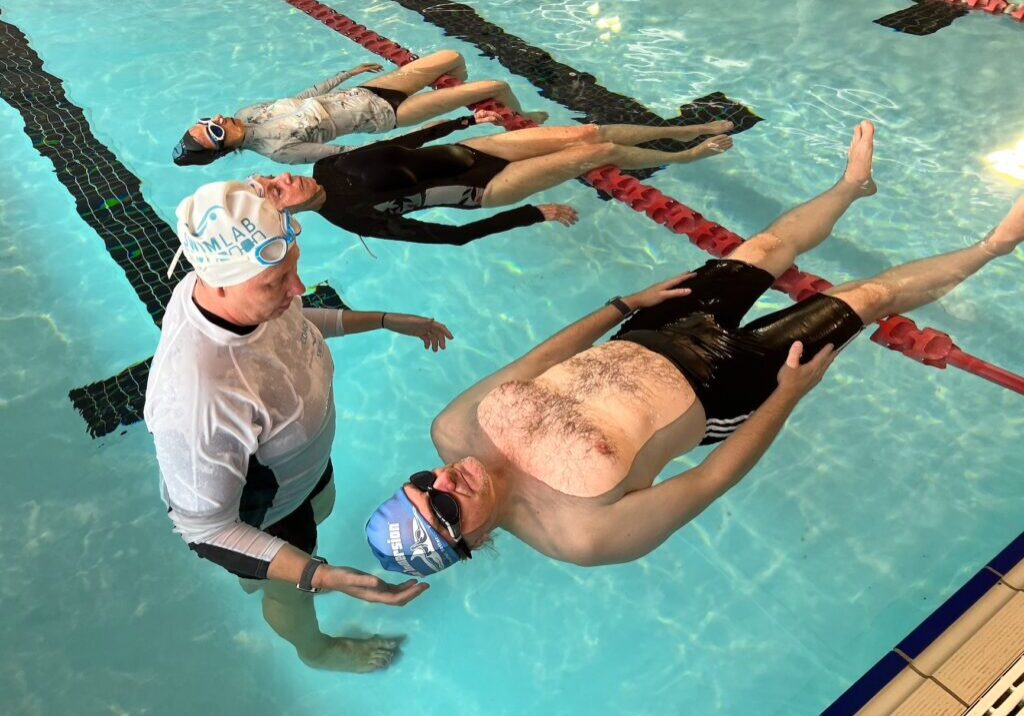
Demonstrations may take place from the poolside or in the water, depending on the skill being taught. For some beginners, having a coach in the water can make it easier to see movements closely and receive immediate support and feedback.
A good demonstration should make the important part of the movement clear rather than simply showing a perfect complete stroke.
Specific, timely feedback
Encouragement matters, but useful feedback also needs to tell a swimmer what happened.
It might identify the one thing that improved, the one thing to notice on the next attempt, or ask the swimmer what they felt during the movement.
Importantly, feedback should not become a constant stream of corrections. Giving a beginner several instructions simultaneously can make learning harder rather than easier.
Often the most useful feedback identifies one priority, allows the swimmer to practise it and then reassesses.
Understanding how the pieces fit together
Adults frequently ask: "But how does this fit into my stroke?" That is a good question.
When a skill is practised in isolation, the swimmer should understand its purpose and how it will eventually connect with the complete movement.
Good coaching helps build that bridge. The aim is not to create a swimmer who can perform a collection of drills. It is to help someone develop a coordinated swimming stroke.
Learning to feel the difference
A coach cannot swim the stroke for the learner. Ultimately, swimmers need to begin recognising effective movement themselves.
Questions such as "What did you notice?", "Did that feel different?", "Where did you feel tension?" and "Which attempt felt easier?" can help develop awareness.
This gradually moves the swimmer away from depending entirely on external instructions and towards becoming capable of evaluating and adjusting their own swimming. That independence is an important part of learning any physical skill.
8. Why Progress Isn't Always Linear
Learning to swim rarely follows a perfectly straight line.
A swimmer may make a significant breakthrough one week and feel as though they have gone backwards the next. A movement that worked yesterday may suddenly feel unfamiliar. A new skill may initially make another part of the stroke feel more difficult.
This does not necessarily mean learning has stopped.
When the brain is developing and refining a complex movement pattern, progress can involve periods of considerable conscious effort. Introducing a new element can temporarily disrupt something that had begun to feel comfortable. Then, with appropriate practice, the pieces start to connect again.
This is particularly important for adults to understand because adults can be highly critical of their own performance. Someone may leave a session thinking, 'I couldn't do it today.' A coach may see something quite different: a swimmer experimenting with a new movement, becoming more aware of what is not working and moving through an important stage of learning.
Improvement isn't always measured in metres
- remaining calmer with the face in the water
- managing the exhale without rushing
- completing several relaxed strokes rather than an entire tense length
- recognising when the head has lifted
- feeling rotation for the first time
- being able to reproduce a movement that previously happened only occasionally
- understanding why one attempt felt easier than another
These changes can seem small. Collectively, they are how swimming develops.
Distance becomes useful later because it allows a swimmer to use established skills for longer periods. But particularly during the early stages, how someone swims can tell us considerably more about their progress than how far they swim.
Learning involves understanding, attempting, receiving information, adjusting and repeating. Some sessions will produce obvious breakthroughs. Others will quietly reinforce a movement that is still becoming familiar. Both are part of the process.
9. Choosing the Right Adult Learn-to-Swim Programme
Not all adult swimming lessons are designed in the same way.
Before enrolling, it is worth looking beyond the timetable and location and asking how the programme actually approaches adult learning.
A good starting point is whether the programme is genuinely designed for adults. Adult beginners can have very different needs from children, and even from adults who can already swim but want to improve their technique.
Look at the group size
Small groups can be particularly valuable during the early stages of learning.
The coach needs time to observe each swimmer, understand what they are experiencing and provide individual feedback. A small group also allows swimmers to progress at slightly different rates without feeling they have to keep up with everyone else.
Ask how many swimmers are normally in a beginner group and whether that number allows for meaningful individual coaching.
Find out where the coach will be
For some adult beginners, particularly those who are less confident in water, having a coach in the water can be extremely helpful.
It allows the coach to demonstrate movements from close range, observe body position from different perspectives and provide reassurance or physical support when appropriate.
As swimmers become increasingly independent, coaching from the poolside may become more suitable. The important question is whether the coaching environment matches the swimmer's current needs.
Ask how skills are taught
A beginner programme should offer more than instructions to swim from one end of the pool to the other.
Ask whether movements are demonstrated, whether complex skills are broken into manageable pieces, whether you will understand why you are practising something and how it fits into the whole stroke, and whether you will receive individual feedback.
Look for opportunities to stop, reset and repeat a skill rather than continually completing lengths. These questions can reveal a great deal about the learning environment.
Consider the role of equipment
Kickboards, fins, pull buoys and other swimming aids can have useful roles in swimming training, but equipment is not necessarily required to learn the fundamental skills of swimming.
For a beginner, it can be valuable to learn how their own body interacts with the water: how to balance, manage breath, change position and create coordinated movement without becoming dependent on an external aid.
Different coaches use equipment in different ways, so it is reasonable to ask what is used and, importantly, why.
Tell the coach about previous experiences
If you have had a frightening, uncomfortable or embarrassing experience in water, it is worth discussing this before lessons begin.
You do not need to provide personal details you would rather keep private. Simply telling a coach that you feel anxious putting your face underwater, dislike being out of your depth or have had a previous experience that affects your confidence gives them useful information.
A good coach should be able to explain how the programme can be adapted and how skills will be introduced progressively.
Choose the right starting level
Being physically fit does not necessarily mean someone should begin in a more advanced swimming group. Swimming ability is skill-specific.
A strong runner or cyclist who cannot comfortably manage their breath or coordinate freestyle may benefit far more from starting with the foundations than struggling through a programme designed for established swimmers.
Starting at an appropriate level is not taking a step backwards. It creates the opportunity to learn well from the beginning.
10. Frequently Asked Questions About Learning to Swim as an Adult
Am I too old to learn to swim?
No. Adults can learn new movement skills throughout life, including swimming.
Age may influence how quickly some physical skills are acquired, but previous experience, confidence, quality of instruction and opportunities to practise are also important. The most useful comparison is not with someone who learned to swim as a child. It is with your own starting point.
How long does it take an adult to learn to swim?
There is no single answer. Someone who is already comfortable in water but has never learned freestyle may progress very differently from someone who has avoided water for decades.
Previous experience, confidence, coordination, frequency and quality of practice all influence the process. It can therefore be more useful to think in terms of skills rather than weeks.
Can you comfortably put your face in the water? Can you manage your breath without urgency? Can you trust the water to support you? Can you maintain balance and body position? Can you repeat several coordinated strokes calmly?
These milestones often tell us more about learning than an arbitrary deadline.
What if I am frightened of water?
Fear of water is not unusual among adult beginners. It may relate to a particular experience or simply to years of feeling uncomfortable in an unfamiliar environment.
The objective should not be to force yourself through that fear. A progressive approach allows you to develop familiarity and control through manageable experiences. Breath management, learning how the body behaves in water and practising within an environment where you feel supported can all contribute to increasing confidence.
If fear is severe or connected with significant trauma, swimming instruction is not a substitute for appropriate professional psychological support. A swim coach's role is to work within their expertise and provide a safe, supportive learning environment in the water.
Do I need to be fit before starting swimming lessons?
No. Learning to swim and swimming for conditioning are different stages of development.
For a beginner, the priority is developing movement that can be repeated without unnecessary tension or significant deterioration in technique.
As that movement becomes more established, practice distances can progressively increase. Greater conditioning follows as the swimmer becomes able to repeat an efficient stroke for longer periods without fatigue significantly changing the movement.
Why do I get so out of breath when I swim?
Feeling out of breath does not always mean you are unfit. Breath holding, rushed exhalation, excessive muscular tension and inefficient movement can all contribute to a feeling of breathlessness in the water.
This is one reason breath management is so important during the early stages of learning.
A swimmer who learns to manage the exhale calmly can then establish movement before the more complex skill of integrating breathing into freestyle is introduced.
Should beginners practise by swimming lots of lengths?
Not necessarily. During skill acquisition, the quality of the movement being repeated is particularly important. Laps will come!
If technique begins to deteriorate after a few strokes, continuing to the end of the pool means repeatedly practising that deteriorated movement.
Short practice repeats can be more productive. Practise the movement while it remains controlled, stop, reset and repeat. As the movement becomes more stable, the number of strokes and distance can gradually increase.
The objective is not to avoid distance forever. It is to build a movement pattern worth taking further. Laps will happen at the right time.
Should adults learn with a kickboard or other swimming equipment?
There is no universal rule. Training equipment can be useful for particular purposes, particularly once a swimmer understands what the equipment is intended to help them practise.
However, beginners also need to learn how their own body balances and moves in water.
If equipment is used, a useful question is: "What skill is this helping me learn?" Equipment should have a purpose rather than simply being present because it has traditionally been part of swimming lessons.
How often should I practise?
Regular, purposeful practice is generally more valuable than occasionally completing a large amount of swimming.
For a beginner, practice does not have to mean a long session. A relatively short period containing several high-quality repetitions of the skill currently being learned can be extremely useful.
What matters is that the swimmer knows what they are practising. Repeating a clear movement objective gives the brain and body opportunities to refine it. Simply accumulating metres without that objective is a different kind of training.
When should I start learning freestyle breathing?
There is no fixed distance or week when breathing must be introduced. Breath management comes first.
A swimmer can learn to become comfortable with the face in the water, develop a calm controlled exhale and begin establishing the basic movement pattern before adding the mechanics of taking a freestyle breath.
Once the stroke is becoming calmer and more repeatable, breathing can progressively be integrated around that movement. This helps avoid making the breath the event that disrupts everything else in the stroke.
Do I need private lessons or can I learn in a group?
Both can work well.
A small adult beginner group can provide individual coaching while also offering the reassurance of learning alongside other adults experiencing similar challenges.
Private coaching may be useful for someone who has significant water anxiety, particular learning needs, limited availability or a specific skill that requires more individual attention.
The quality and suitability of the coaching are more important than assuming one format is automatically better.
11. Learning to Swim as an Adult: What Matters Most
Learning to swim as an adult is not simply about reaching the other end of the pool.
It is the process of learning a complex movement skill in an unfamiliar environment.
Adults bring previous experiences with them. Some arrive excited to learn. Others bring uncertainty, frustration or fear. Some have tried lessons before. Some have spent decades believing that swimming simply is not something they can do.
Good learning begins by recognising that starting point.
Breath management can help create the calm and attention required for learning. Complex movements can then be broken into manageable pieces, understood, practised over short repeats and refined through quality feedback.
As those movements become more familiar, they begin to connect. What initially requires considerable concentration gradually becomes more coordinated and increasingly automatic.
Distance can then grow with the skill.
There will be sessions where progress feels obvious and others where it does not. Learning is rarely perfectly linear, particularly when an adult is replacing movement or behavioural responses that may have been reinforced over many years.
The objective is not perfection. It is progressively developing a way of moving through the water that feels calm, controlled, efficient and repeatable.
And for an adult beginning that process, a few well-practised strokes can sometimes represent far more progress than another length of the pool.
About This Guide
This guide is intended as general educational information for adults considering learning to swim. Individual experiences and learning needs vary, and swimming instruction should always take place in an environment appropriate to the swimmer's ability and water confidence.